

In dental 3D printing, resolution and printing accuracy are two important technical specifications that directly relate to the quality of printed restorations, dental models, and surgical guides. However, these terms are often misunderstood or used interchangeably.
A 3D printer with higher resolution does not necessarily produce more dimensionally accurate parts. Understanding the difference between these two parameters helps dental laboratories evaluate equipment more effectively and select the right printing solution for their applications.
So, what exactly do resolution and printing accuracy mean, and how do they affect dental 3D printing?
1. What Is 3D Printer Resolution?
Resolution refers to the printer’s ability to reproduce small details or control the positioning of printed material within a given space. In resin-based dental 3D printers, resolution is generally described in terms of XY resolution and Z-axis layer thickness.
XY Resolution
XY resolution describes the physical size represented by one pixel on the printing plane.
For example, if a printer has an XY resolution of 50 μm, each pixel corresponds to approximately 50 μm in the X-Y plane.
A smaller pixel size generally allows the printer to reproduce finer details and more precisely define the boundaries of small structures.
However, the actual detail quality also depends on optical performance, light scattering, exposure settings, and resin characteristics.
Z-Axis Resolution
Z-axis resolution is commonly associated with layer thickness, which determines how much the build platform moves vertically between successive printing layers.
For example:
- 25 μm layer thickness: More layers are used to build the same object.
- 50 μm layer thickness: Fewer layers are required.
- 100 μm layer thickness: The printing process uses thicker layers.
Smaller layer thickness can improve the reproduction of curved surfaces and reduce visible layer lines. However, it does not automatically guarantee better dimensional accuracy in the Z direction.
It is important to distinguish nominal layer thickness from actual Z-axis positioning accuracy.
2. What Is 3D Printing Accuracy?
Printing accuracy refers to how closely the dimensions and geometry of a printed object match the original digital design.
Unlike resolution, which describes the printer’s spatial detail capability, accuracy evaluates the actual printing result.
For example, suppose a dental crown has a designed length of 10 mm in CAD software.
| Actual printed length | Dimensional deviation |
|---|---|
| 10.00 mm | 0 μm |
| 10.02 mm | +20 μm |
| 9.97 mm | -30 μm |
| 10.05 mm | +50 μm |
In this example, a printed crown measuring 10.02 mm has a positive dimensional deviation of 20 μm.
Printing accuracy can be evaluated by measuring specific dimensions or comparing the complete printed geometry with the original CAD model through 3D scanning.
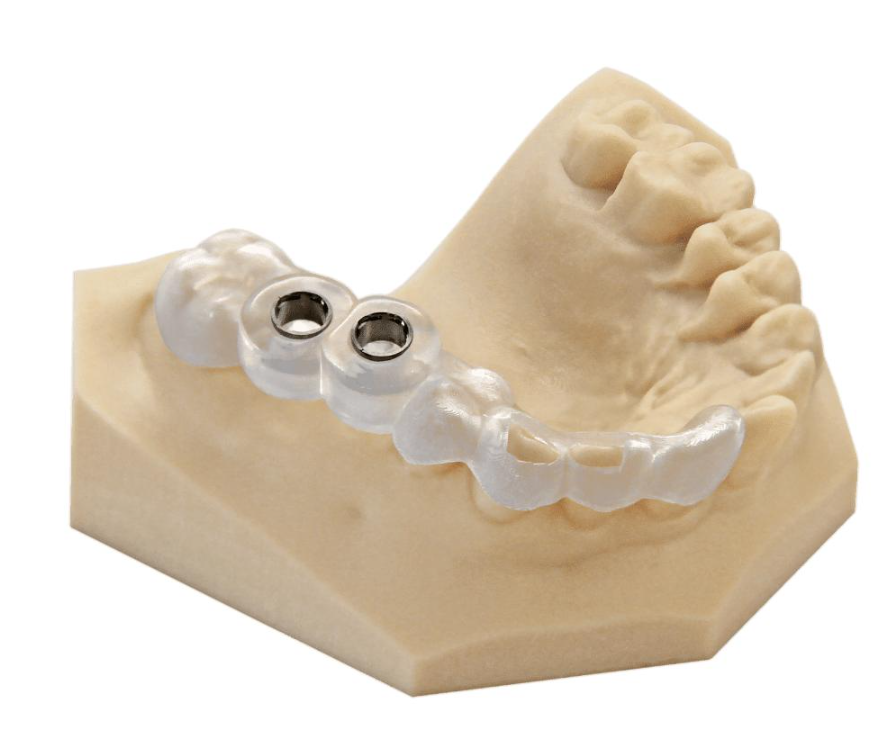
For dental applications, this is particularly important because dimensional deviations may affect marginal fit, contact relationships, occlusion, and the adaptation of dental appliances.
3. What Factors Affect Dental 3D Printing Accuracy?
Printing accuracy is influenced by several interconnected factors. Pixel size and layer thickness are only part of the equation.
3.1 Optical System Performance
The optical system determines how light is delivered to the photosensitive resin.
Uneven light intensity, optical distortion, and light scattering can affect polymerization boundaries. As a result, the actual cured dimensions may differ from the intended digital geometry.
3.2 Resin Properties and Polymerization Shrinkage
Photosensitive resin undergoes polymerization during exposure. This chemical reaction can cause volumetric shrinkage.
The amount of shrinkage depends on resin formulation, exposure conditions, and curing behavior.
If shrinkage is not properly controlled or compensated for, the final printed object may exhibit dimensional deviations.
3.3 Exposure Parameters
Exposure time and light energy influence how much resin polymerizes during each printing cycle.
Insufficient exposure may result in incomplete curing or weak bonding between layers. Excessive exposure may cause light to spread beyond the intended boundaries, producing dimensional enlargement or loss of fine details.
Therefore, appropriate exposure calibration is essential.
3.4 Mechanical Stability
The movement of the build platform, Z-axis positioning system, and overall mechanical structure can affect dimensional consistency.
Mechanical vibration, platform misalignment, or positioning deviations may introduce errors during printing.
3.5 Printing Orientation and Post-Processing
Printing orientation affects support placement, layer formation, and the distribution of forces during printing.
After printing, washing and post-curing also influence the final dimensions. Inadequate or inconsistent post-processing may result in residual resin, incomplete polymerization, or additional dimensional changes.
4. Resolution vs. Printing Accuracy: What Is the Difference?
Although these two parameters are related, they measure different aspects of printer performance.
| Comparison | Resolution | Printing Accuracy |
|---|---|---|
| Main definition | Ability to reproduce fine details | Closeness to the original design |
| Evaluation focus | Spatial detail capability | Dimensional and geometric deviation |
| Common specifications | Pixel size, layer thickness | μm or mm deviation |
| Main influencing factors | Optical system, pixel size, layer thickness | Exposure, resin, mechanics, calibration, post-processing |
| Practical significance | Detail reproduction | Dimensional fit and consistency |
Consider two hypothetical dental 3D printers:
| Specification | Printer A | Printer B |
|---|---|---|
| XY resolution | 35 μm | 50 μm |
| Layer thickness | 25 μm | 50 μm |
| Measured dimensional deviation | ±50 μm | ±30 μm |
Printer A has a smaller pixel size and thinner printing layers. However, Printer B demonstrates a smaller dimensional deviation under the assumed test conditions.
This example illustrates an important point: higher resolution does not necessarily mean higher printing accuracy.
The two parameters should be evaluated independently rather than treated as interchangeable indicators of overall print quality.
5. Which Parameter Matters More for Different Dental Applications?
Both resolution and accuracy are important, but their relative importance depends on the intended application.
Surgical Guides
Surgical guides require accurate positioning of guide sleeves and precise adaptation to the supporting anatomy.
Dimensional accuracy and positional accuracy are particularly important because deviations may affect the intended surgical guidance.
Temporary Crowns
For temporary crowns and bridges, both fine detail reproduction and dimensional accuracy matter.
Resolution contributes to the reproduction of margins and surface details, while accuracy affects the restoration’s fit, contact points, and occlusal relationships.
Dental Models
Dental models require sufficient resolution to reproduce tooth morphology, preparation margins, and other fine anatomical features.
At the same time, dimensional accuracy is essential for ensuring that the printed model represents the original digital impression correctly.
6. How to Evaluate 3D Printer Specifications Before Purchasing?
When comparing dental 3D printers, looking at resolution alone is not enough. Dental laboratories should evaluate several technical parameters together.
1. Check XY resolution
Determine whether the stated value represents the physical pixel size on the printing plane. A smaller pixel size may support finer detail reproduction, but it does not independently establish actual accuracy.
2. Check Z-axis specifications
Distinguish between minimum layer thickness and actual Z-axis positioning accuracy. They describe different technical capabilities.
3. Ask about printing accuracy and test conditions
Check whether the manufacturer provides dimensional deviation data and whether the results come from standardized test models or actual dental applications.
4. Evaluate material compatibility
Different photosensitive resins have different polymerization and shrinkage characteristics. Printer performance should be evaluated using the materials and curing conditions intended for actual production.
5. Consider the complete workflow
Printing accuracy depends on more than the printer itself. Resin preparation, exposure calibration, printing orientation, washing, and post-curing all contribute to the final result.
Conclusion
Resolution and printing accuracy are two distinct but closely related specifications in dental 3D printing.
Resolution describes the printer’s ability to reproduce fine details, while printing accuracy measures how closely the final printed object matches the original digital design.
A printer with higher resolution may produce finer details, but this does not automatically mean it will deliver better dimensional accuracy.
For dental laboratories, the best approach is to evaluate both parameters alongside material properties, exposure control, mechanical stability, and post-processing requirements.
Understanding these differences makes it easier to interpret technical specifications and select a dental 3D printing solution that meets the practical requirements of daily laboratory production.
Post time: Oct-30-2026