

Dental all-ceramic materials have become an important part of modern restorative dentistry. However, the term “all-ceramic” covers a wide range of materials with significantly different compositions, microstructures, mechanical properties, optical characteristics, and clinical applications.
Simply dividing all-ceramic materials into “glass ceramics” and “zirconia” is useful as a starting point, but it does not fully explain why different ceramic materials behave differently or why the same material may be suitable for one restoration but less appropriate for another.
A more systematic approach is to classify dental all-ceramic materials from three dimensions:
- Material composition
- Microstructure
- Clinical performance
These three dimensions are closely related. In simple terms, composition influences microstructure, microstructure affects material properties, and material properties influence clinical applications.
1. Classification by Material Composition
The first dimension is the chemical and material composition of the ceramic.
From this perspective, dental all-ceramic materials can broadly be divided into glass-based ceramics and oxide ceramics.
1.1 Glass-Based Ceramics
Glass-based ceramics contain a significant glass phase. Their optical properties are generally one of their major advantages, making them particularly useful when appearance is an important consideration.
Common categories include:
- Feldspathic ceramics
- Leucite-reinforced ceramics
- Lithium disilicate ceramics
Because these materials contain a glass phase, many glass-based ceramics can be treated through established adhesive bonding protocols. Their combination of translucency, color reproduction, and sufficient mechanical strength makes them useful for a variety of esthetic restorations.
Typical applications include:
- Veneers
- Inlays and onlays
- Anterior crowns
- Selected posterior single crowns
However, glass-based ceramics generally do not reach the same mechanical strength and fracture toughness as high-strength oxide ceramics.
1.2 Oxide Ceramics
Oxide ceramics are primarily composed of crystalline oxide phases rather than a glass matrix.
Important categories include:
- Alumina
- Zirconia
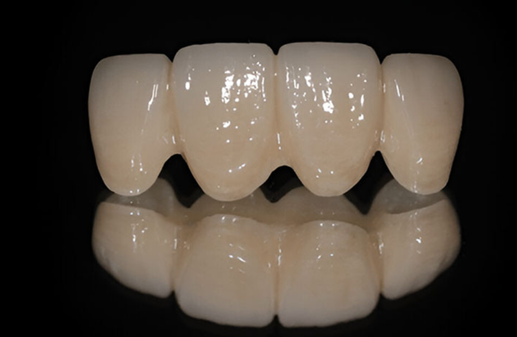
Among these materials, zirconia has become particularly important in digital dentistry because of its high strength, fracture resistance, and compatibility with CAD/CAM manufacturing.
Unlike conventional glass ceramics, zirconia does not contain a significant glass phase. Therefore, conventional hydrofluoric acid etching is not the primary surface treatment approach for zirconia. Depending on the clinical protocol, mechanical surface treatment and appropriate chemical bonding strategies may be used.
Zirconia is commonly used for:
- Single crowns
- Posterior restorations
- Multi-unit bridges
- Implant-supported restorations
- Full-arch restorations
The key advantage of oxide ceramics is their mechanical performance, although their optical behavior differs from that of glass-based ceramics.
2. Classification by Microstructure
Chemical composition alone does not fully explain the behavior of a ceramic material. The second dimension is its microstructure.
From a structural perspective, all-ceramic materials can be broadly understood as:
- Glass-based ceramics
- Particle-reinforced glass ceramics
- Polycrystalline ceramics
The proportion and arrangement of glass and crystalline phases have a major influence on strength, fracture resistance, translucency, and processing behavior.
2.1 Glass-Based Structure
In a glass-based ceramic, the glass phase forms the main structural matrix.
Because light can pass through the relatively homogeneous glass matrix, these materials can provide high optical quality.
Their main characteristics include:
- High translucency
- Good optical integration
- Relatively lower mechanical strength compared with polycrystalline ceramics
This structure is particularly relevant when optical properties are prioritized.
2.2 Particle-Reinforced Glass Ceramic Structure
Particle-reinforced glass ceramics contain crystalline phases distributed within a glass matrix.
The crystalline phase can reinforce the glass matrix and improve mechanical performance while maintaining many of the optical advantages associated with glass-based ceramics.
Lithium disilicate is a representative example of this structural concept.
Compared with conventional glass-based ceramics, particle-reinforced glass ceramics generally provide:
- Higher strength
- Improved fracture resistance
- Good translucency
- A balance between mechanical and optical properties
This combination makes them useful for both esthetic and functional restorations.
2.3 Polycrystalline Structure
Polycrystalline ceramics are primarily composed of tightly packed crystalline grains and contain little or no glass phase.
Zirconia is a major example.
The absence of a glass matrix contributes to its different mechanical and surface-treatment characteristics.
Typical features include:
- High flexural strength
- High fracture toughness
- Good resistance to crack propagation
- Strong mechanical performance
The microstructure of zirconia can also vary depending on its composition and crystal phase distribution. This is one reason why different zirconia materials can show different combinations of strength and translucency.
3. Classification by Clinical Performance
The third dimension focuses on how the material performs in clinical situations.
Instead of asking only “What is the material made of?”, this approach asks:
What balance of properties does the restoration require?
From this perspective, all-ceramic materials can be broadly discussed as esthetic-oriented, function-oriented, or balanced materials.
3.1 Esthetic-Oriented Ceramics
Esthetic-oriented ceramics place greater emphasis on optical properties such as:
- Translucency
- Color integration
- Light transmission
- Natural appearance
Examples may include highly translucent glass ceramics and selected high-translucency zirconia materials.
These materials can be considered when the restoration is located in a highly visible area and optical integration is a major concern.
Typical applications include:
- Anterior veneers
- Anterior crowns
- Esthetic single-unit restorations
However, high translucency should not be considered independently from mechanical requirements. The material still needs to meet the functional demands of the specific restoration.
3.2 Function-Oriented Ceramics
Function-oriented ceramics emphasize mechanical performance.
Important properties include:
- Flexural strength
- Fracture toughness
- Resistance to crack propagation
- Long-term structural stability
High-strength zirconia is commonly associated with this category.
These materials can be considered for restorations exposed to greater mechanical demands, such as:
- Posterior crowns
- Multi-unit bridges
- Implant-supported restorations
- Full-arch restorations
For these applications, structural requirements may become more important than maximizing translucency.
3.3 Balanced Ceramics
Some ceramic materials are designed to achieve a balance between esthetics and mechanical performance.
The objective is not to maximize one property, but to provide a combination that is suitable for a wider range of clinical situations.
Depending on the specific material, this balance may involve:
- Moderate to high strength
- Controlled translucency
- Natural color behavior
- Suitable processing characteristics
Certain lithium disilicate materials and zirconia materials with intermediate optical and mechanical characteristics can fall into this broad category.
The appropriate choice still depends on the restoration design, location, thickness, occlusal conditions, and other clinical factors.
4. How the Three Dimensions Are Connected
The three classification dimensions should not be considered as three completely independent systems.
They describe different aspects of the same material.
Composition → Microstructure → Properties → Clinical Application
For example, zirconia is an oxide ceramic from the perspective of composition.
Its polycrystalline microstructure helps explain its high mechanical performance.
That mechanical performance, in turn, makes zirconia suitable for restorations where strength and fracture resistance are important.
Similarly, a glass-based ceramic has a different composition and microstructure. Its optical behavior and bonding characteristics make it particularly useful for applications where esthetics and adhesive bonding are important.
This relationship can be summarized as:
Material composition determines the basic structural framework.
↓
Microstructure determines how the material behaves.
↓
Material properties determine its clinical potential.
↓
Clinical requirements determine whether the material is appropriate for a specific restoration.
5. Why a Three-Dimensional Classification Is Useful
A simple material classification can sometimes lead to an overly broad understanding of all-ceramic materials.
For example, saying that a material is “zirconia” tells us something about its composition, but it does not automatically tell us its exact translucency, strength, phase composition, or clinical indication.
Likewise, identifying a material as a “glass ceramic” does not provide enough information to determine whether it is best suited for a veneer, anterior crown, or posterior restoration.
A three-dimensional classification provides a more complete framework.
| Dimension | Main Question | Key Factors |
|---|---|---|
| Material Composition | What is the material made of? | Glass-based ceramics, oxide ceramics |
| Microstructure | How is the material internally structured? | Glass phase, crystalline phase, polycrystalline structure |
| Clinical Performance | What does the material need to do? | Esthetics, strength, fracture resistance, bonding |
This framework also helps explain why two materials belonging to the same broad category can still behave differently.
6. Choosing the Right Ceramic Requires More Than One Property
There is no single material property that determines whether a ceramic is appropriate for a restoration.
Material selection should consider the relationship between:
- Restoration type
- Restoration location
- Available material thickness
- Functional loading
- Esthetic requirements
- Preparation design
- Bonding protocol
- CAD/CAM processing
- Finishing and sintering procedures
For example, a highly translucent material may be attractive for an anterior restoration, while a restoration exposed to greater functional loading may require a stronger material.
Similarly, a material with high mechanical strength is not automatically the best choice for every highly esthetic restoration.
The objective is therefore not simply to select the material with the highest strength or highest translucency. Instead, the material should provide an appropriate balance of properties for the intended clinical application.
Conclusion
Dental all-ceramic materials can be understood more clearly through a three-dimensional classification system.
The first dimension is material composition, which distinguishes major material families such as glass-based ceramics and oxide ceramics.
The second dimension is microstructure, which explains the relationship between glass phases, crystalline phases, and polycrystalline structures.
The third dimension is clinical performance, which considers whether a material is primarily oriented toward esthetics, mechanical function, or a balance of both.
Understanding these three dimensions provides a more practical way to evaluate ceramic materials.
Rather than asking only “Which ceramic is stronger?” or “Which ceramic is more translucent?”, a more useful question is:
“What combination of composition, microstructure, and properties is appropriate for this specific restoration?”
That perspective can help clinicians and dental technicians make more informed material-selection decisions within modern digital restorative workflows.
Post time: Sep-24-2026