

Applications and Performance Evaluation of Multilayer Zirconia in Digital Dental Restorations
Introduction
Digital dental restorations demand materials that provide both aesthetic appeal and mechanical reliability. Multilayer zirconia blocks are increasingly used for crowns, bridges, and full-arch restorations because they combine gradient color layers with high flexural strength, allowing predictable results in CAD/CAM workflows. This article examines the applications and performance evaluation of multilayer zirconia in modern dental laboratories.
Material Properties of Multilayer Zirconia
Multilayer zirconia blocks are engineered with discrete color and translucency layers, offering a natural enamel-to-dentin gradient:
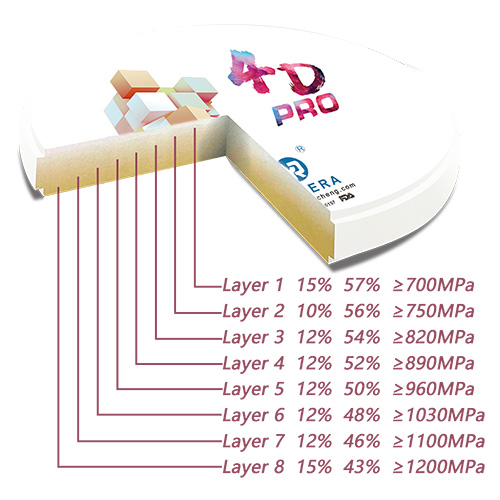
Translucency gradient: 43–57% from incisal to cervical regions, providing aesthetic realism.
Flexural strength: 700–1200 MPa, suitable for load-bearing posterior restorations.
Layered design: Typically 8 layers, reducing the need for additional manual staining.
These properties make multilayer zirconia suitable for single crowns, multi-unit bridges, and full-arch prosthetics, ensuring consistent shade and structural performance.
Applications in Digital Restorations
1. Single Crowns
Multilayer zirconia provides natural color transitions for anterior crowns.
CAD/CAM milling ensures precise fit and preserves color gradient.
Reduces manual adjustments, improving lab efficiency.
2. Multi-Unit Bridges
Bridges require both strength and shade consistency across multiple units.
Multilayer blocks maintain flexural strength up to 1200 MPa in posterior regions.
Gradient layers allow uniform aesthetic outcomes from incisal to cervical surfaces.
3. Full-Arch Restorations
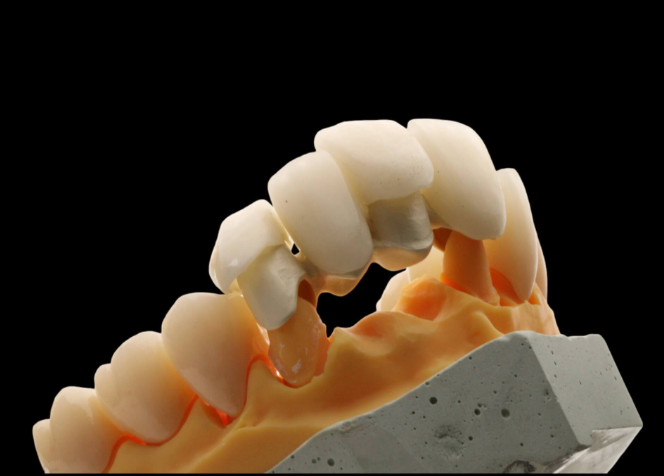
Layered zirconia blocks can be milled into full-arch prosthetics while preserving both color gradient and mechanical integrity.
CAD/CAM precision (±0.05 mm) ensures proper fit and occlusion.
Performance Evaluation
Mechanical Performance
Load-bearing capacity: Verified flexural strength supports posterior bridges under occlusal forces.
Dimensional stability: Controlled sintering schedules prevent distortion and maintain gradient alignment.
Aesthetic Performance
Shade reproducibility: Built-in gradient reduces variability between units.
Surface quality: Minimal post-processing required, preserving the natural enamel effect.
Laboratory Workflow Efficiency
Digital integration: CAD/CAM milling preserves gradient and minimizes human-dependent errors.
Reduced manual staining: Saves labor and ensures consistent color across multiple restorations.
Best Practices for Dental Labs
Proper Block Orientation: Ensures intended color gradient is maintained.
Milling Accuracy: Sub-millimeter precision prevents fit issues and preserves aesthetic layers.
Sintering Protocol Adherence: Maintains mechanical properties and color consistency.
Material Selection: Choose block strength and layer gradient based on restoration type.
Training and Calibration: Technicians must understand orientation, milling strategy, and post-processing to achieve predictable results.
Case Insights and Technical Observations
Multi-unit bridges fabricated with multilayer zirconia demonstrated consistent shade across all units, minimizing adjustments.
Posterior crowns maintained functional integrity under normal occlusal loads (700–1200 MPa flexural strength).
Digital workflows significantly reduced processing time and manual interventions, supporting high-volume production.
These observations indicate that multilayer zirconia is both aesthetic and mechanically reliable, making it a practical material for modern digital dental laboratories.
Conclusion
The use of multilayer zirconia in digital dental restorations combines mechanical reliability with aesthetic precision. Gradient layers, verified flexural strength, and CAD/CAM compatibility allow dental labs to produce consistent crowns and bridges efficiently. Correct block orientation, precise milling, and controlled sintering are essential to fully leverage these material properties, ensuring predictable outcomes across single crowns, multi-unit bridges, and full-arch restorations.
Post time: May-04-2026