

With the development of digital dentistry, 3D printing materials have become increasingly diverse. Conventional photopolymer resin and ceramic-filled resin are two materials that use light-induced polymerization to form solid structures. However, their compositions, material structures, and performance characteristics are significantly different.
The main distinction is that conventional photopolymer resin primarily consists of an organic polymer matrix, whereas ceramic-filled resin combines an organic resin matrix with inorganic ceramic particles to form a composite material.
So, how does adding ceramic fillers change the properties of a resin material? And why does this combination make ceramic-filled resin suitable for certain dental restorative applications?
1. What Are the Differences in Material Composition?
The fundamental difference between conventional photopolymer resin and ceramic-filled resin lies in their composition.
Conventional Photopolymer Resin
Conventional photopolymer resin is primarily composed of organic chemical components. Its formulation typically includes:
- Oligomers: Form the main polymer framework and influence mechanical properties.
- Reactive diluents (monomers): Adjust viscosity and participate in polymerization.
- Photoinitiators: Absorb light energy and generate reactive species to initiate polymerization.
- Additives: Help regulate properties such as color, stability, and processing performance.
When exposed to light of an appropriate wavelength, the reactive components polymerize and form a crosslinked organic network.
The final material is therefore primarily an organic polymer structure.
Ceramic-Filled Resin
Ceramic-filled resin contains both an organic resin matrix and inorganic ceramic fillers. Its formulation generally includes:
- Resin matrix: Provides the continuous polymer structure.
- Inorganic ceramic fillers: Modify mechanical and optical properties.
- Coupling agents: Help improve the interaction between ceramic particles and the resin matrix.
- Photoinitiators: Initiate the light-induced polymerization process.
- Other additives: Adjust viscosity, color, stability, and other formulation characteristics.
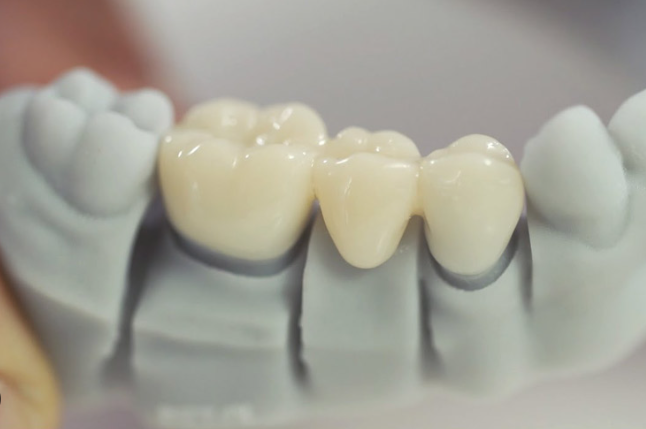
Unlike conventional photopolymer resin, ceramic-filled resin contains solid inorganic particles distributed throughout the organic resin matrix.
After curing, these particles remain incorporated into the polymer network, forming an organic-inorganic composite material.
An important point is that ceramic fillers do not polymerize under light exposure. Instead, they are physically incorporated into the resin matrix, with their interface interaction contributing to the overall properties of the composite.
2. How Do the Two Materials Cure?
Although their compositions are different, conventional photopolymer resin and ceramic-filled resin generally share the same fundamental curing mechanism: photopolymerization.
The process involves several stages.
Step 1: Light Absorption
When the material is exposed to light at an appropriate wavelength, the photoinitiator absorbs the light energy.
Step 2: Free Radical Generation
The activated photoinitiator generates free radicals, which initiate polymerization reactions involving reactive monomers and oligomers.
Step 3: Polymer Chain Formation
The reactive components begin to polymerize. As the reaction progresses, molecular chains grow and crosslink with one another.
Step 4: Formation of a Solid Structure
The liquid resin gradually transforms into a solid material through the formation of a three-dimensional polymer network.
The main difference appears in the final material structure.
- Conventional photopolymer resin: Light curing produces a predominantly organic polymer network.
- Ceramic-filled resin: Light curing forms an organic polymer network that incorporates inorganic ceramic particles.
Therefore, the ceramic fillers do not undergo ceramic sintering during ordinary light curing. The material remains an organic-inorganic composite rather than becoming a fully sintered ceramic.
3. How Does Ceramic Filler Addition Affect Material Properties?
Adding inorganic ceramic fillers changes the structure of the resin material and can influence several important properties.
However, these changes depend on filler composition, particle size, concentration, distribution, and the quality of the interface between the fillers and resin matrix.
3.1 Mechanical Properties
Ceramic fillers can modify the stiffness, hardness, and wear behavior of the composite.
The inorganic particles can help reinforce the resin matrix by contributing to load distribution and restricting local deformation.
However, higher filler content does not automatically mean better mechanical performance.
For example:
- Higher filler loading may increase elastic modulus and hardness.
- Poor particle dispersion may create local defects.
- Weak filler-matrix bonding may reduce the effectiveness of reinforcement.
- Excessive filler loading may make processing more difficult and can negatively affect other properties, including toughness.
Consequently, mechanical performance depends on the overall formulation rather than filler content alone.
3.2 Optical Properties
Optical properties are particularly important for dental restorative materials.
The interaction between light and a composite material is influenced by several factors, including:
- Ceramic particle size and distribution.
- Filler concentration.
- Refractive index differences between the filler and resin matrix.
- Material thickness and internal structure.
When light passes through a composite, differences in refractive index between the organic and inorganic phases can cause light scattering.
By adjusting filler characteristics and the resin formulation, manufacturers can regulate translucency and light transmission.
This is important for achieving an appearance that is suitable for different restorative indications.
3.3 Polymerization Shrinkage and Dimensional Stability
Conventional photopolymer resin undergoes volumetric shrinkage during polymerization because reactive molecules form new chemical bonds and move closer together.
Ceramic fillers are generally non-reactive during the polymerization process and do not undergo the same polymerization shrinkage as the organic resin components.
As a result, incorporating inorganic fillers can reduce the proportion of shrinkable organic material in a composite.
However, the actual shrinkage behavior also depends on the resin chemistry, filler loading, particle characteristics, and curing conditions.
Therefore, ceramic-filled resin may exhibit reduced polymerization shrinkage compared with an otherwise comparable unfilled resin formulation, but the actual result must be established through testing.
4. Why Can Ceramic-Filled Resin Be Used for Dental Restorations?
Dental restorative materials must satisfy requirements beyond simply forming a solid structure after curing.
They need to withstand the mechanical environment of the oral cavity while maintaining appropriate optical properties and biological compatibility.
Ceramic-filled resin is designed to combine the processing characteristics of photopolymer materials with the property-modifying effects of inorganic fillers.
Three aspects are particularly important.
4.1 Improved Mechanical Performance
Inorganic ceramic fillers can contribute to the stiffness, hardness, and wear characteristics of the composite.
These properties are relevant to dental restorations because restorations are exposed to repeated chewing forces and contact with opposing teeth.
Nevertheless, the suitability of a material depends on its complete mechanical profile, including flexural strength, fracture toughness, and fatigue resistance.
4.2 Adjustable Optical Characteristics
Natural teeth have complex optical characteristics, including translucency, light scattering, and color variations.
The optical behavior of ceramic-filled resin can be adjusted through the selection of filler particles and the design of the resin formulation.
This provides opportunities to develop materials with optical characteristics suitable for different dental applications.
4.3 Potential for Improved Dimensional Stability
The incorporation of inorganic fillers can reduce the amount of polymerizable organic material within a given volume.
This may help reduce overall polymerization shrinkage and contribute to dimensional stability.
However, dimensional accuracy also depends on printing parameters, layer exposure, post-curing conditions, and material processing procedures.
For this reason, the complete manufacturing process must be considered when evaluating the accuracy of a printed restoration.
5. Conventional Photopolymer Resin vs. Ceramic-Filled Resin: A Summary
| Comparison | Conventional Photopolymer Resin | Ceramic-Filled Resin |
|---|---|---|
| Main composition | Organic resin components | Organic resin matrix + inorganic ceramic fillers |
| Material structure | Polymer network | Organic-inorganic composite |
| Curing mechanism | Photopolymerization | Photopolymerization |
| Filler content | Usually absent or relatively low | Contains inorganic ceramic particles |
| Mechanical properties | Primarily determined by polymer formulation | Influenced by both polymer matrix and fillers |
| Optical properties | Determined by resin formulation | Influenced by resin and ceramic filler characteristics |
| Polymerization shrinkage | Depends on resin chemistry | May be reduced through filler incorporation |
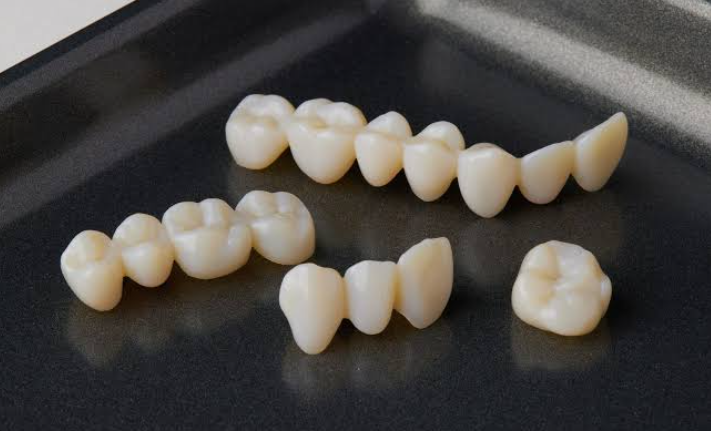
| Dental applications | Models and various dental printing applications | Selected restorative applications, depending on validated material properties |
Conclusion
The fundamental difference between conventional photopolymer resin and ceramic-filled resin is not their curing mechanism, but their material composition and resulting structure.
Both materials rely on photopolymerization to transform liquid resin into a solid structure. However, ceramic-filled resin incorporates inorganic ceramic particles into the organic polymer matrix, creating a composite material with different mechanical, optical, and dimensional characteristics.
It is also important to recognize that adding ceramic fillers does not automatically improve every property. Filler type, particle size, concentration, dispersion, and interface bonding all play important roles in determining the final material performance.
Understanding these differences helps dental professionals and dental laboratories better evaluate the characteristics and potential applications of different 3D printing materials.
Post time: Nov-27-2026