

Zirconia staining is an important step in dental restoration fabrication, helping dental laboratories achieve natural-looking shades and customized color effects. Among the commonly used application methods, immersion staining and brush-on staining offer two different approaches to delivering coloring solutions into zirconia.
Although both methods can be used for internal coloring, they differ in how the staining solution contacts the zirconia, how its application is controlled, and how color distribution is achieved.
Understanding these differences helps dental technicians select an appropriate staining method for different restoration requirements.
1. How Does Immersion Staining Work?
Immersion staining is a traditional coloring method in which a zirconia restoration or blank is placed directly into a staining solution for a specified period.
During this process, the liquid comes into contact with the exposed surfaces of the zirconia. Through wetting and capillary penetration, the solution can move into accessible pores and interconnected spaces within the material.
The main stages include:
- Full or partial immersion: The zirconia restoration is placed into the staining solution, allowing the liquid to contact the target surfaces.
- Liquid penetration: The solution moves through accessible pore structures and channels within the zirconia.
- Colorant distribution: Coloring components carried by the liquid enter the material and become distributed within the accessible regions.
- Drying and sintering: After the appropriate treatment, the restoration is dried and sintered according to the material manufacturer’s instructions, allowing the final color to develop.
Key Factors Affecting Immersion Staining
The final coloring result depends on several factors:
- Immersion time: Determines how long the zirconia remains in contact with the solution.
- Pore structure: Influences how easily the liquid can penetrate the material.
- Solution concentration: Affects the amount of coloring components available for penetration.
- Liquid viscosity: Influences wetting and liquid movement.
- Pre-sintered zirconia condition: The material’s density, porosity, and surface condition affect liquid absorption.
Immersion staining is particularly suitable for applications requiring overall coloring because the solution can contact multiple surfaces simultaneously.
2. How Does Brush-on Staining Work?
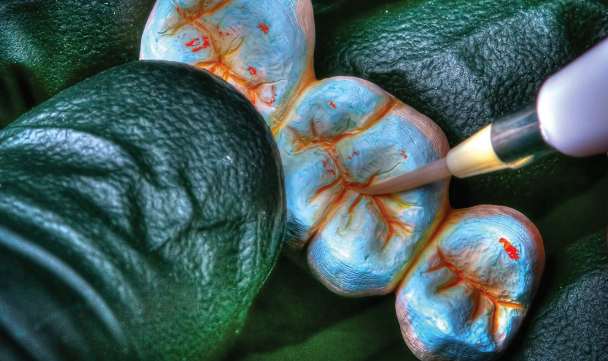
Brush-on staining applies the coloring solution directly to selected areas of a zirconia restoration using a brush or a specialized application tool.
Unlike immersion staining, which exposes the entire restoration to the solution, brush-on staining allows technicians to control where the liquid is applied and how much solution is deposited.
The coloring mechanism still relies on liquid wetting and penetration into accessible regions of the zirconia.
The process generally involves four stages:
- Targeted application: The technician applies the staining solution to specific areas of the zirconia restoration.
- Surface wetting: The liquid spreads across the applied area and establishes contact with the zirconia surface.
- Internal penetration: The solution moves into accessible pores and channels through capillary action and other liquid transport mechanisms.
- Color development: After drying and sintering, the coloring components contribute to the final shade of the restoration.
Key Factors Affecting Brush-on Staining
Brush-on staining requires careful control of the application process.
Important factors include:
- Application position: Determines which parts of the restoration receive the staining solution.
- Application volume: Influences the amount of liquid available for penetration.
- Number of applications: Multiple applications may change the total amount of solution deposited.
- Brushing consistency: Helps reduce uneven liquid distribution.
- Solution concentration: Influences the amount of coloring components delivered.
- Zirconia porosity: Determines the material’s ability to absorb and retain the solution.
Because the technician can apply different amounts of solution to different areas, brush-on staining offers greater flexibility for localized color adjustments.
3. Immersion vs. Brush-on Staining: What Are the Main Differences?
Both methods use liquid-based coloring mechanisms, but their application strategies are different.
| Comparison | Immersion Staining | Brush-on Staining |
|---|---|---|
| Application method | Dipping the restoration into a solution | Applying the solution with a brush |
| Contact area | Overall or selected immersed surfaces | Specifically targeted areas |
| Liquid distribution | Primarily determined by immersion conditions | Controlled by application position and volume |
| Color adjustment | Mainly through immersion parameters | Through application position, volume, and frequency |
| Operational flexibility | Suitable for overall coloring | Suitable for localized coloring |
| Main advantage | Convenient for treating multiple surfaces | Flexible control over individual regions |
The fundamental difference is not necessarily how the coloring components penetrate the zirconia, but how the staining solution is delivered to the material.
Both methods can achieve internal coloring when the solution penetrates the zirconia structure rather than remaining only on its surface.
4. Does Brush-on Staining Provide Deeper Penetration?
One common question is whether brush-on staining allows the coloring solution to penetrate deeper into zirconia than immersion staining.
The answer is not necessarily.
Penetration depth is influenced by several material and process-related factors, including:
1. Zirconia porosity
The pore structure determines the accessible pathways through which the liquid can move. More accessible pores may facilitate liquid penetration, while a denser structure can restrict it.
2. Solution properties
Viscosity, surface tension, concentration, and wetting behavior all influence how the solution interacts with the zirconia surface and moves through its pore structure.
3. Application conditions
Immersion time, brushing frequency, liquid volume, and drying conditions can affect the amount and distribution of the solution.
4. Material condition
The density and surface condition of the pre-sintered zirconia also influence liquid absorption.
Therefore, brush-on staining should not automatically be considered superior to immersion staining in terms of penetration depth.
Its main distinction is the ability to control the application location and liquid distribution.
5. Why Is Brush-on Staining an Important Development?
The value of brush-on staining lies in its application flexibility and potential for more precise color design.
5.1 More Flexible Regional Color Control
Natural teeth do not have a uniform color from the cervical region to the incisal edge.
The cervical region generally appears more saturated, while the incisal region may show greater translucency and different optical characteristics.
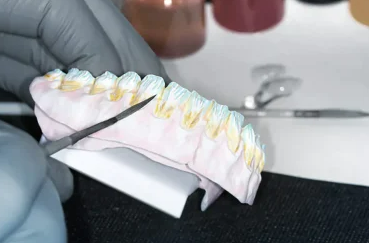
Brush-on staining allows technicians to apply coloring solutions to selected regions according to the desired shade distribution.
This provides more flexibility when reproducing natural tooth color characteristics.
5.2 Adjustable Coloring Intensity
By controlling the application volume and number of applications, technicians can adjust the amount of staining solution delivered to different regions.
This makes it possible to develop customized coloring procedures for different restoration designs.
However, the final color response also depends on the zirconia composition, solution formulation, and sintering conditions.
5.3 More Flexible Color Gradient Design
Brush-on staining can be used to create regional color transitions by applying different coloring solutions or varying application conditions across the restoration.
For example:
- Cervical region: Apply a more saturated shade when required.
- Middle region: Use an intermediate shade to create a natural transition.
- Incisal region: Apply a lighter shade or reduce the coloring intensity according to the desired appearance.
The result depends on the staining protocol and the optical properties of the zirconia material.
6. Internal Staining vs. Surface Staining: An Important Distinction
It is important not to confuse the application method with the location where the color is ultimately formed.
Internal staining refers to a coloring process in which coloring components penetrate into the zirconia body.
Surface staining, on the other hand, refers to coloring that primarily remains on the restoration surface or within an applied surface layer.
Both immersion and brush-on methods can be used for internal staining.
The use of a brush does not automatically mean that the process is surface staining. Likewise, immersion does not guarantee uniform internal color penetration.
The actual distinction depends on how deeply the coloring components enter the zirconia and how they are distributed within the material.
Conclusion
Immersion staining and brush-on staining are two different approaches to applying coloring solutions to dental zirconia.
Immersion staining provides broad liquid contact and is suitable for overall coloring. Brush-on staining offers greater flexibility in controlling application position, liquid volume, and regional color distribution.
Neither method is universally better. The appropriate choice depends on the restoration design, zirconia structure, desired color effect, and staining protocol.
As dental restoration requirements become increasingly focused on natural aesthetics and customized color reproduction, application methods that provide better control over the coloring process offer valuable possibilities for dental laboratories.
Post time: Nov-13-2026