

When people evaluate a beautiful smile, they usually focus on tooth color, shape, and alignment. However, natural teeth have a much more complex optical behavior that goes beyond simple color matching.
One of the key characteristics that gives natural teeth their vitality and realistic appearance is fluorescence.
This unique optical property allows natural teeth to interact with light in a way that creates a more lifelike appearance. For modern dental restorations, especially ceramic and zirconia restorations, understanding fluorescence has become increasingly important for achieving natural esthetics.
So, why do natural teeth appear to “glow”? And why does fluorescence matter in dental restorations?
What Is Tooth Fluorescence?
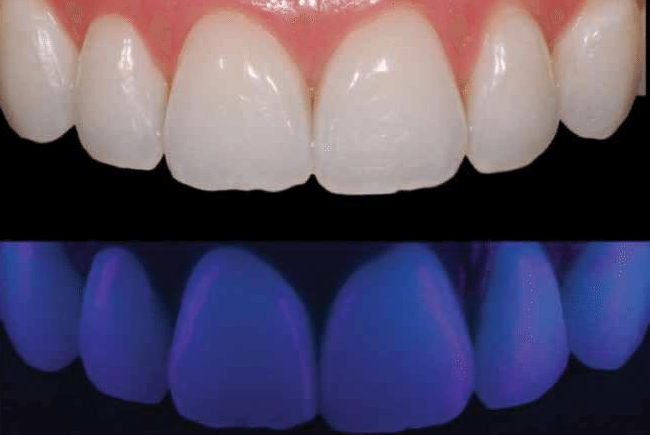
Dental fluorescence is the phenomenon where a tooth absorbs invisible ultraviolet (UV) light energy and releases part of that energy as visible light.
In simple terms:
Natural teeth can absorb certain wavelengths of light and emit a soft blue-white glow.
This effect is usually not noticeable under normal daylight conditions. However, under specific lighting environments, such as:
- UV lighting
- Special photography conditions
- Stage lighting
- Certain indoor lighting environments
the fluorescence of natural teeth becomes more visible.
This optical response is one of the reasons natural teeth maintain a lively appearance instead of looking flat or artificial.
Why Do Natural Teeth Have Fluorescence?
Natural teeth are composed mainly of two important structures:
- Enamel
- Dentin
Both contribute to the appearance of teeth, but they play different roles.
The Role of Enamel
Enamel is the outer protective layer of the tooth and the hardest biological material in the human body.
Its main optical characteristics include:
- High mineral content
- Light transmission
- Transparency
- Surface reflection
Compared with dentin, enamel has relatively limited fluorescence because it contains fewer organic components.
However, enamel plays an important role in controlling how light enters, travels through, and exits the tooth.
The Role of Dentin
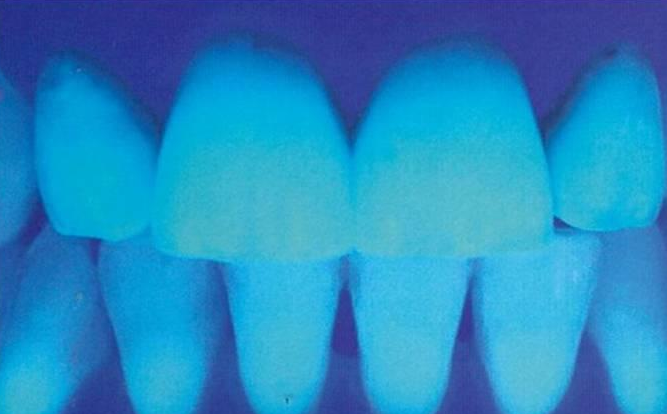
Dentin contributes more significantly to tooth fluorescence.
It contains:
- Organic matrix
- Collagen structures
- Mineral components
These natural components can absorb ultraviolet energy and release visible light.
Because dentin has stronger fluorescence characteristics, it greatly influences the overall vitality and brightness of natural teeth.
This is why dental restorations must not only reproduce the external color of enamel but also consider the internal optical behavior of dentin.
Why Fluorescence Matters in Dental Esthetics
Modern dentistry has moved beyond simply creating “white teeth.”
A natural-looking restoration needs to reproduce multiple optical properties, including:
- Shade
- Translucency
- Opalescence
- Fluorescence
Without proper fluorescence, a restoration may appear:
- Too opaque
- Too bright
- Artificial under certain lighting conditions
Even if the shade is correct, the restoration may still look different from surrounding natural teeth.
Fluorescence helps restorations achieve:
- More natural brightness
- Better integration with adjacent teeth
- More realistic appearance under different lighting environments
Why Do Some Dental Restorations Look Artificial?
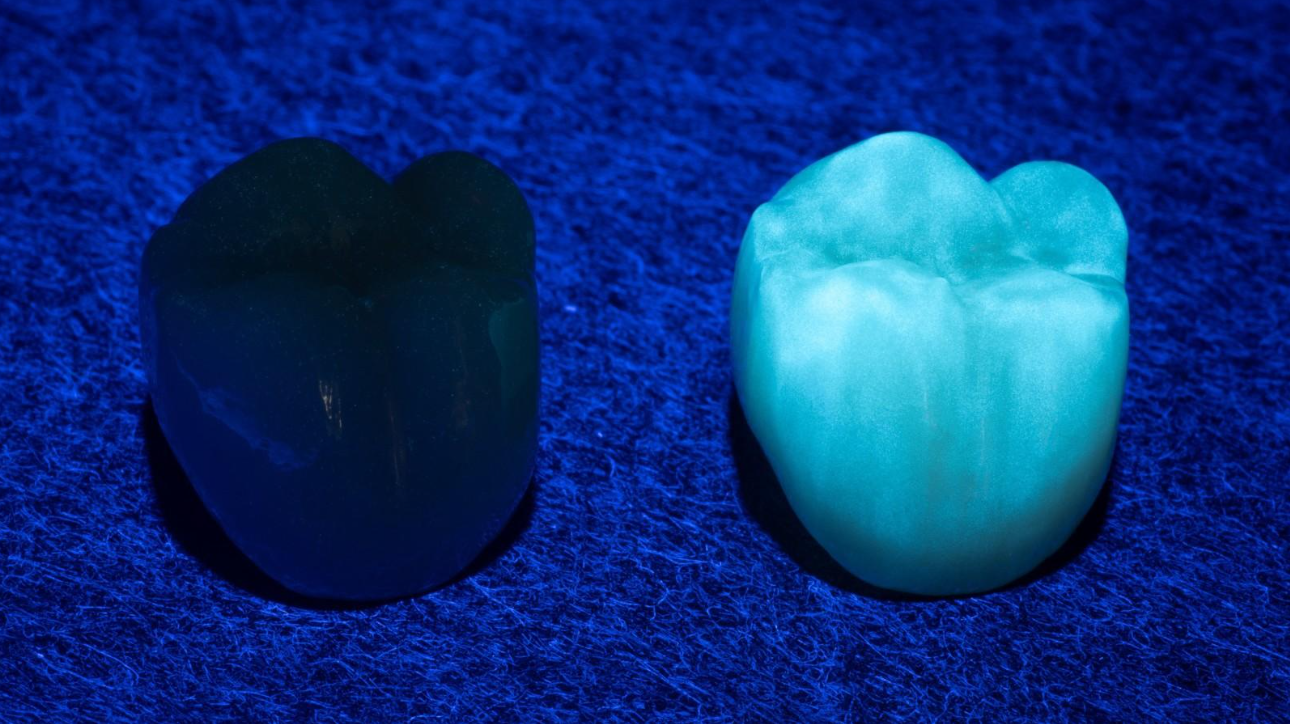
Many patients and dentists have experienced situations where a crown looks acceptable in the dental chair but appears unnatural in photographs or special lighting.
One possible reason is that the restoration does not reproduce the same optical response as natural teeth.
Traditional restorative materials may have limitations such as:
- Insufficient translucency
- Lack of fluorescence
- Excessive opacity
- Limited light interaction
A successful aesthetic restoration is not only about matching the tooth color chart. It is about recreating how natural teeth interact with light.
The Importance of Fluorescence in Zirconia Restorations
Zirconia has become one of the most widely used materials in modern CAD/CAM dentistry because of its excellent mechanical strength and biocompatibility.
However, strength alone is not enough for highly aesthetic restorations.
Modern zirconia materials are continuously improved to better simulate natural tooth characteristics, including:
Improved Translucency
Natural teeth allow a certain amount of light transmission.
Modern multilayer zirconia achieves more natural light behavior through optimized translucency gradients.
Shade Transition
Natural teeth are not one single color. They gradually change from the cervical area to the incisal edge.
Multilayer zirconia blocks reproduce this natural color transition to improve aesthetic outcomes.
Fluorescence Performance
Adding fluorescence characteristics helps zirconia restorations appear more natural under different lighting conditions.
This is especially important for:
- Anterior crowns
- Veneers
- Smile design cases
- Full-mouth aesthetic rehabilitation
Fluorescence, Translucency, and Opalescence: What Is the Difference?
These three optical properties are often discussed together but have different meanings.
| Optical Property | Function |
|---|---|
| Translucency | Determines how much light can pass through the restoration |
| Fluorescence | Creates light emission when exposed to UV energy |
| Opalescence | Produces natural color shifts and blueish effects at certain angles |
A simple way to understand them:
Translucency makes teeth look natural.
Fluorescence makes teeth look alive.
Opalescence makes teeth look dynamic.
Together, these characteristics create the complex appearance of natural teeth.
Why Fluorescence Is Important for Modern Digital Dentistry
As CAD/CAM dentistry continues to develop globally, dental laboratories require materials that combine both mechanical performance and natural aesthetics.
A successful restoration must balance:
- Strength
- Accuracy
- Durability
- Optical properties
For dental laboratories, especially those producing aesthetic restorations, selecting materials with natural optical characteristics can significantly improve the final restoration quality.
Modern zirconia blocks are no longer designed only for fracture resistance. They are engineered to better reproduce the appearance of natural teeth through:
- Multilayer structures
- Controlled translucency
- Natural shade gradients
- Improved optical behavior
How Dentists and Dental Laboratories Can Achieve More Natural Restorations
To create restorations that closely resemble natural teeth, professionals should consider:
1. Selecting the Right Material
Different clinical cases require different zirconia characteristics.
Anterior aesthetic cases may require higher translucency and improved optical performance, while posterior restorations may prioritize strength.
2. Understanding Tooth Structure
A restoration should consider both enamel and dentin characteristics rather than focusing only on surface color.
3. Using Digital Workflow Technology
CAD/CAM technology allows laboratories to achieve:
- Precise restoration design
- Consistent material processing
- Better communication between dentists and technicians
Conclusion
Natural teeth are much more complex than simply being white structures. Their beauty comes from a combination of biological structure and optical properties, including fluorescence.
Fluorescence allows teeth to interact with light in a unique way, creating the natural vitality that patients expect from a beautiful smile.
For modern dental restorations, especially zirconia-based CAD/CAM solutions, reproducing these optical characteristics has become an essential part of achieving highly aesthetic results.
The future of dental materials is not only about creating stronger restorations—it is about creating restorations that better replicate the structure, function, and optical behavior of natural teeth.
Post time: Jul-09-2026